
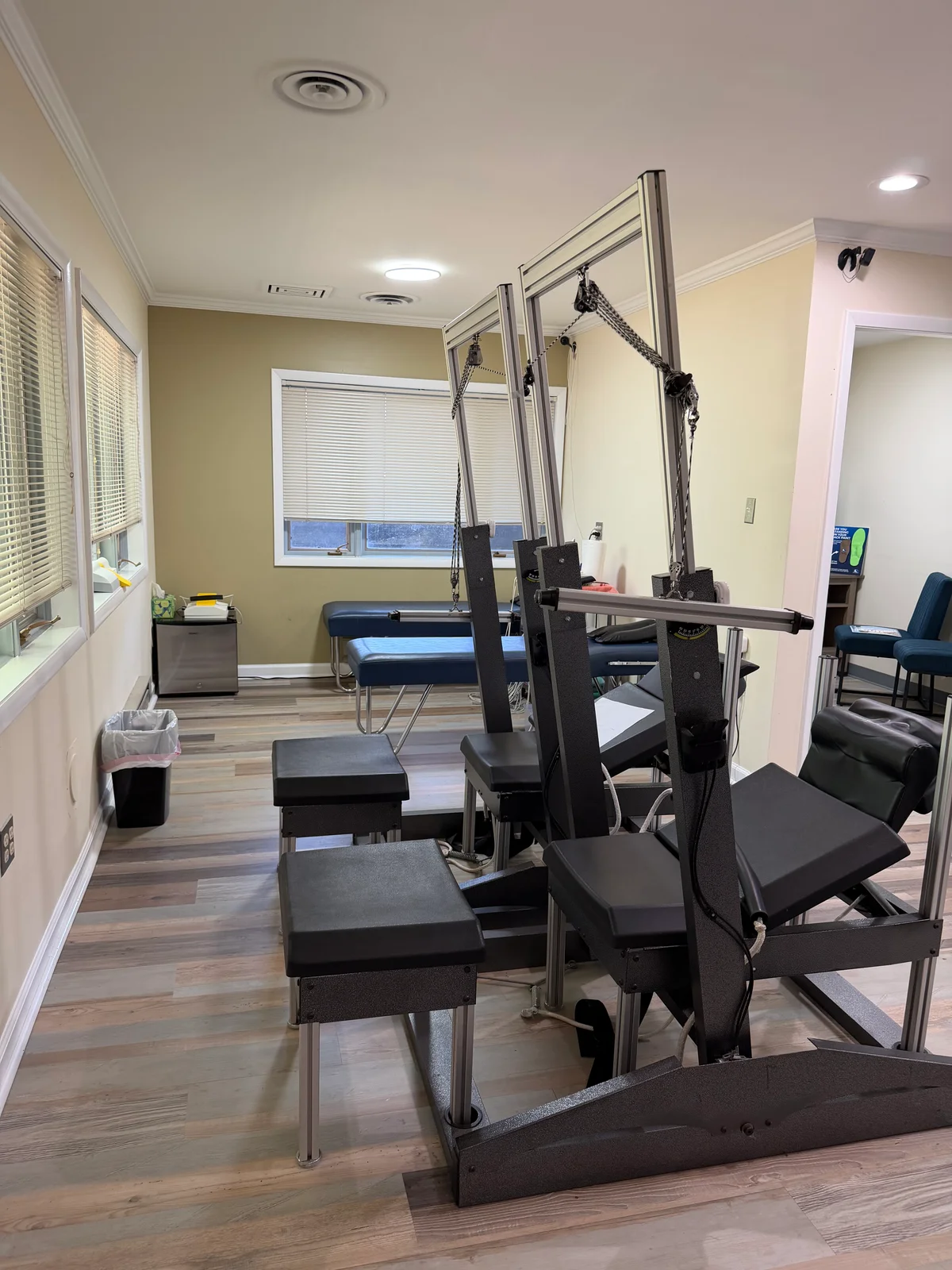
What Rehab Covers Here
Two kinds of rehab work are offered at the Towson clinic: rehabilitative exercise and electric muscle stimulation. Equipment at this clinic also includes vibe plates and wobble chairs.
The National Library of Medicine's overview of rehabilitation says the specific goals are different for each person.
Who Does the Work: Chiropractic Assistants
Chiropractic assistants do the exercise and muscle stimulation work. A chiropractor on staff oversees the chiropractic assistants, and all assistants are registered and trained.
The Maryland Board of Chiropractic Examiners registers chiropractic assistants and says they may work only under the guidance of a supervising chiropractor.
Why Rehab Centers on Movement
Pain changes how a body moves. Muscles around a sore area can stay tight to protect it, while others do less and lose strength. You may start favoring one side without noticing, and that habit can outlast the injury that started it.
Rehab is aimed at what the injury leaves behind. Stretching is meant to give tight muscles more length, and strengthening is meant to give the spine and joints more support.
Balance work trains proprioception, your body's sense of where it is and how it is moving. The thinking behind wobble chairs and vibe plates is to give that sense something to respond to.
Cleveland Clinic's explanation of proprioception calls it your body's ability to sense its own position and movements.
What Exercise Adds to Hands-On Care
An adjustment or a device session is done for you. Exercise is the part you do yourself, and it keeps asking a muscle to work after a visit ends. Holistic care means rehab is planned around your own life: a program for long days at a desk may look nothing like one for heavy lifting.
Order matters as well. A sore area may need room to settle before it takes on more, so a program may begin with easy motion and build from there. If your evaluation traces the pain to a disc or a pressed nerve, other care may come first or run alongside the exercises.
Rehabilitative Exercise
Rehabilitative exercise is offered at this clinic. A session may include stretches to loosen tight muscles and exercises to strengthen weak ones.
Rehab exercises and stretching may come up in care for back pain, sciatica, herniated and bulging discs or car accident injuries.
After our comprehensive evaluation, a service like this may be recommended, depending on your condition.
Electric Muscle Stimulation
Electric muscle stimulation is available at this clinic. It sends an electrical current into a muscle.
Muscles normally tighten when a nerve signals them to. A stimulator supplies that signal from outside, so the muscle contracts without you trying. Doctors use these devices for goals such as retraining a muscle after a serious injury or easing a spasm. The thought is that it can help a muscle not yet ready to work hard alone.
Cleveland Clinic's guide to electrical stimulation says electrical impulses can make muscles contract.
Your evaluation covers your health history, including any implanted device, pregnancy or medicines, to determine if you are a candidate.
Class IV Laser and Shockwave
Class IV laser therapy and shockwave therapy are also offered at this clinic.
Before Rehab Starts
New patients may begin with a detailed intake, then a care plan built around their needs. If you also see another doctor, rehab may be combined with that care, so mention what you already get.
Session length, cost and insurance are questions for a phone call to the clinic.
Near Ridgeleigh and Cromwell Valley Park
Ridgeleigh is about a mile east of the clinic, and Cromwell Valley Park is about 2 miles northeast. Along E Joppa Rd, LaSalle Rd is about 0.2 miles east and Mylander Ln about 0.3 miles east.